



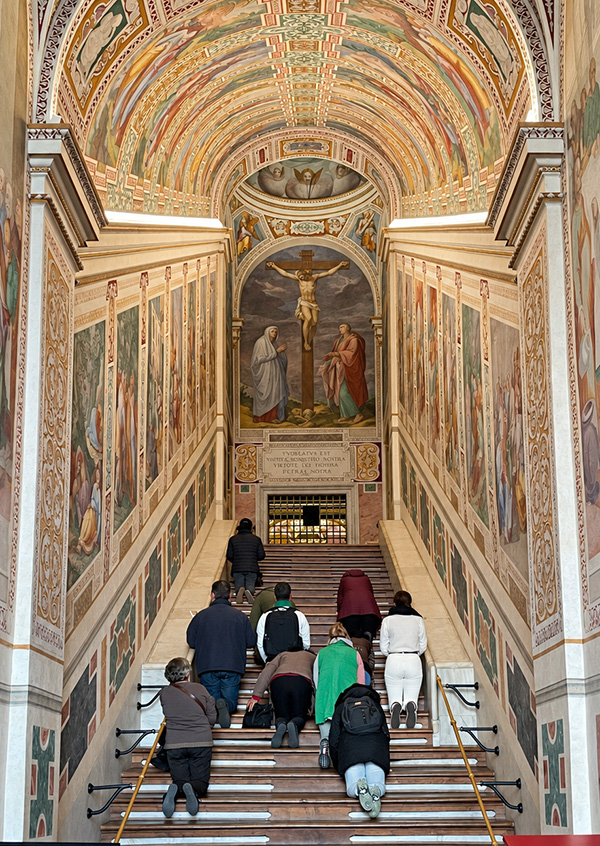
 Opposite the Basilica of Saint John Lateran stands the Pontifical Sanctuary of the Scala Sancta, one of Rome’s most important pilgrimage destinations. Its spiritual and architectural heart is the Holy Staircase: twenty-eight marble steps traditionally identified as those from the praetorium of Pontius Pilate in Jerusalem. According to ancient Christian tradition, Jesus ascended these stairs during his Passion, and Saint Helena, mother of Emperor Constantine, brought them to Rome around 326.
The stairs were originally associated with the Patriarchium, the vast Lateran Palace that served as the principal residence of the popes throughout much of the Middle Ages. Their present setting dates to the pontificate of Sixtus V. Between 1586 and 1589, the pope commissioned architect Domenico Fontana to construct a new sanctuary in which the Holy Stairs formed the ceremonial approach to the ancient papal chapel known as the Sancta Sanctorum. The surrounding stairways and vaulted passages were decorated with extensive fresco cycles depicting the Passion of Christ and episodes from the Old Testament.
Pilgrims ascend the central staircase only on their knees, pausing in prayer on each step. This penitential devotion is not the worship of marble as an object, but a physical meditation on Christ’s suffering, judgment, and journey toward the Cross. Wooden coverings installed to protect the marble from centuries of wear contain openings through which portions of the original steps may be seen and venerated.
At the summit stands the Sancta Sanctorum, originally the private chapel of the popes and dedicated to Saint Lawrence. Documented since at least the early Middle Ages, it acquired its name—“Holy of Holies”—because of the exceptional collection of sacred relics preserved beneath its altar. A cypresswood ark dating from the time of Pope Leo III still holds numerous relics associated with early Christian saints and, according to tradition, the earthly life and Passion of Jesus Christ.
Among the objects associated with the sanctuary is a wooden fragment identified by the Latin inscription Pars lectuli in quo D. N. feria V. in Coena recubuit—“Part of the couch upon which Our Lord reclined at supper on Holy Thursday.” The relic is traditionally believed to come from the dining couch used by Christ during the Last Supper. In the ancient world, formal meals were commonly eaten while reclining, making “dining couch” a more precise translation of the Latin lectulus than “bed.”
Catholic veneration of this relic is directed not toward the material object itself, but toward Christ and the institution of the Eucharist commemorated on Holy Thursday. It serves as a tangible witness to the Incarnation and the historical setting of the Last Supper.
Together, the Holy Stairs, the sacred relics, and the ancient icon of the Most Holy Savior transform the Scala Sancta into a profound Sanctuary of the Passion, where history, sacred art, and bodily prayer unite in contemplation of Christ’s sacrifice and Resurrection.