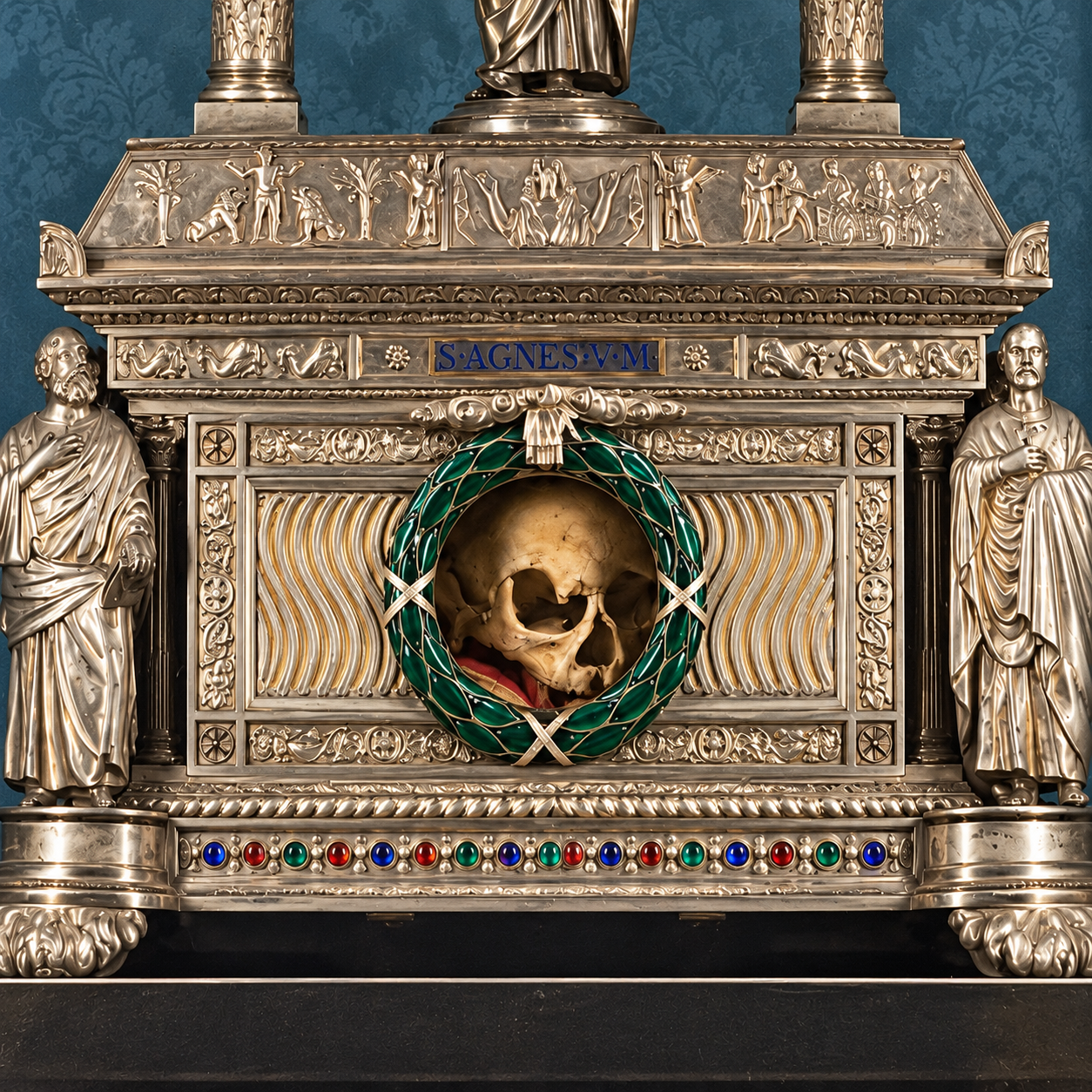


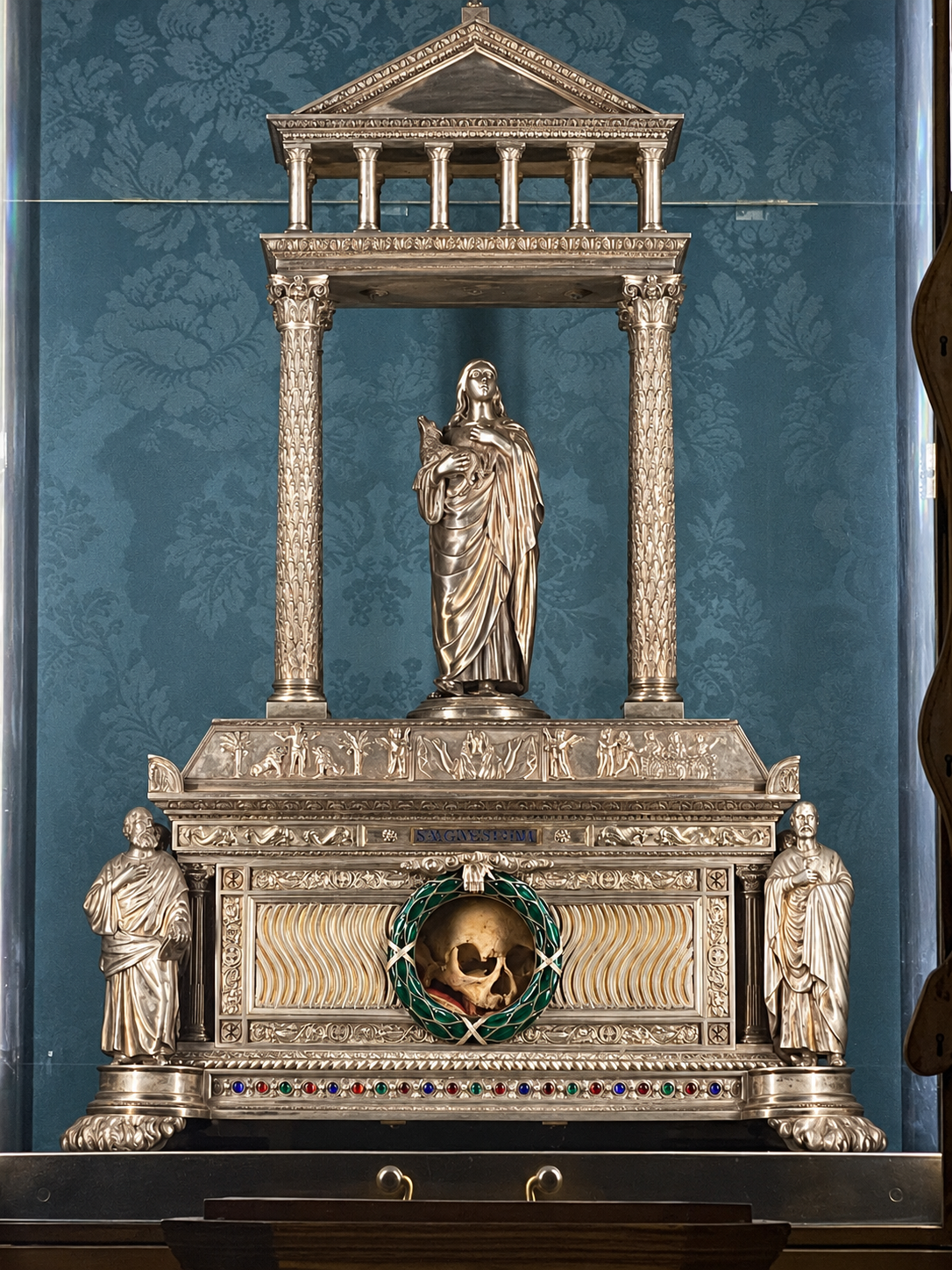
 In the heart of Rome’s Piazza Navona, the magnificent Baroque church of Sant’Agnese in Agone preserves one of the city’s most revered early Christian relics: the head of St. Agnes of Rome. Enshrined within a silver architectural reliquary, the relic provides a direct devotional connection with the young virgin-martyr whose courage made her one of the most beloved saints of Christian antiquity.
St. Agnes was born into a Roman Christian family during the late third century. According to ancient tradition, she consecrated her virginity to Christ while still a child and refused marriage despite threats and persecution. During the persecutions associated with Emperor Diocletian, Agnes was condemned for her Christian faith. Western tradition holds that she was killed by the sword, like a sacrificial lamb, at approximately twelve or thirteen years of age. Her name, resembling the Latin agnus, meaning “lamb,” became closely associated with innocence, purity, and martyrdom. Her feast is celebrated on January 21.
The place of her martyrdom was traditionally identified with the Stadium of Domitian, whose elongated arena survives in the shape of modern Piazza Navona. According to the medieval account, Agnes was publicly exposed there, but her hair miraculously grew to cover and protect her. The crypt beneath Sant’Agnese in Agone preserves part of the ancient stadium and has been venerated as the site of her suffering and death since at least the seventh century.
After her martyrdom, Agnes’s body was buried in her family’s cemetery on the Via Nomentana. The great basilica of Sant’Agnese fuori le Mura was later built above her tomb and continues to preserve the principal relics of her body. Her head, however, followed a different history. In the ninth century it was transferred to the private chapel of the popes. In 1900, Pope St. Pius X presented the sacred relic to Sant’Agnese in Agone, returning it to the place traditionally associated with the saint’s martyrdom. It is now displayed for veneration in the Chapel of the Holy Head.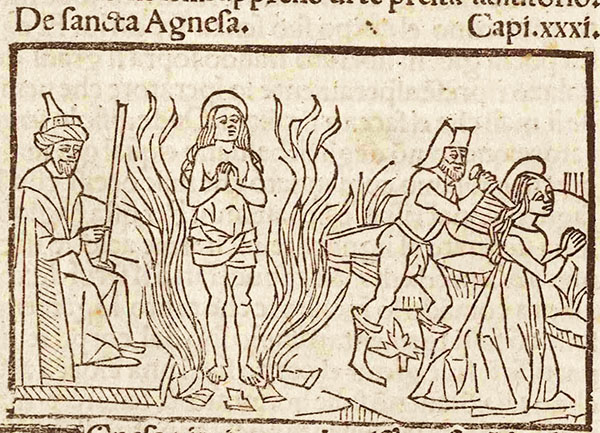
The present church was commissioned by Pope Innocent X Pamphilj in the seventeenth century beside his family palace. Construction began in 1652 under Girolamo and Carlo Rainaldi and was transformed by Francesco Borromini, who designed the dramatic concave façade and soaring dome. Its Greek-cross interior, enriched with colored marble, gilded decoration, sculptures, and frescoes, forms one of the masterpieces of Roman Baroque architecture. Beneath its splendor, the surviving crypt preserves the church’s most ancient spiritual memory.
Veneration of the head of St. Agnes unites the relic with the physical setting of her witness. The skull is not honored as an isolated historical object, but as the mortal remains of a saint whose life belonged entirely to Christ. Before it, pilgrims remember the dignity of the human body, the Christian hope of resurrection, and the extraordinary courage of a young girl who preferred fidelity to her faith over life itself. Together, Sant’Agnese in Agone and Sant’Agnese fuori le Mura preserve the divided relics of Agnes while expressing a single, enduring devotion to Rome’s virgin-martyr.