



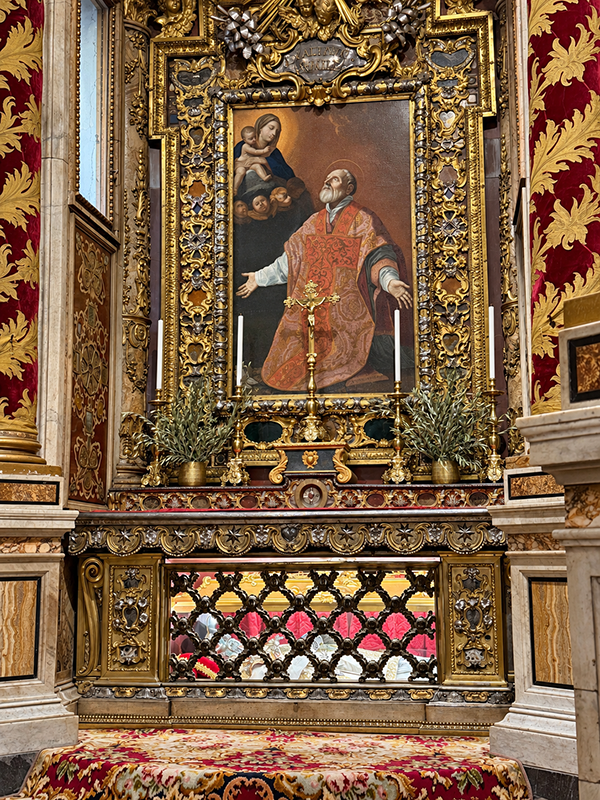
 The Cappella di San Filippo Neri is one of the most important places of pilgrimage in Rome. Located to the left of the sanctuary in the Church of Santa Maria in Vallicella—better known as the Chiesa Nuova—the chapel houses the venerated body of Saint Philip Neri, the beloved sixteenth-century priest remembered as the “Apostle of Rome.”
Philip Neri was born in Florence in 1515 and settled in Rome as a young man. There, he devoted himself to prayer, charitable work, and the spiritual formation of people from every level of society. His joyful manner, personal humility, and ability to guide souls earned him the affectionate Roman nickname Pippo Buono, or “Good Philip.” In 1575 Pope Gregory XIII formally approved the Congregation of the Oratory founded by Philip and entrusted its members with the small medieval church of Santa Maria in Vallicella. Because the existing building was unable to accommodate the growing congregation, it was replaced by a much larger church, soon popularly called the Chiesa Nuova.
Construction began in 1575 and continued under several architects, including Matteo da Città di Castello and Martino Longhi the Elder. The church was consecrated in 1599, four years after Philip’s death, while its façade was completed in the early seventeenth century. During the following decades, the interior acquired its magnificent Baroque decoration. Pietro da Cortona painted the great frescoes of the nave, dome, and apse, while Peter Paul Rubens created three celebrated works for the high altar, including the composition surrounding the miraculous image of the Madonna della Vallicella.
The Chapel of Saint Philip was constructed between 1600 and 1606. The saint’s body was solemnly transferred there in 1602, twenty years before his canonization by Pope Gregory XV in 1622. Its sumptuous decoration contrasts strikingly with Philip’s own preference for simplicity. Precious marbles, alabaster, jasper, mother-of-pearl, lapis lazuli, onyx, agate, and other costly materials transform the chapel into a radiant architectural reliquary. Above the altar is an image of the saint in prayer before the Virgin and Child, while beneath it his remains are visible behind an elaborately worked metal grille.
For Catholics, the veneration of Saint Philip’s relics is not worship of the saint’s physical remains. Rather, it is an expression of honor for a life transformed by divine grace and a tangible connection with the communion of saints. Pilgrims kneel before the chapel to ask Philip’s intercession, especially for spiritual joy, perseverance in prayer, and guidance in times of difficulty.
The saint’s presence continues to define the Chiesa Nuova. Nearby, his preserved rooms contain personal objects, relics, his bed, and his confessional. Together, the church, chapel, and rooms form an extraordinary spiritual memorial to a man whose warmth, humor, and charity permanently shaped the religious life of Rome.