



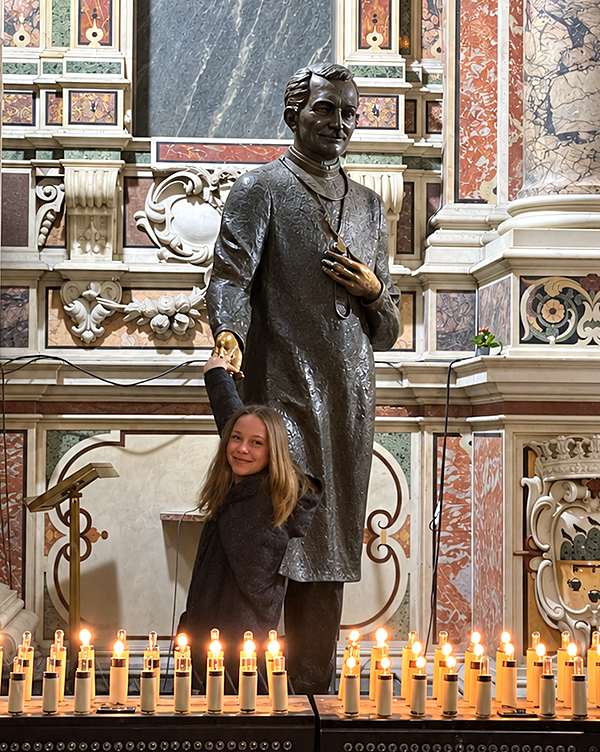
 In the heart of Naples, within the magnificent Baroque Church of Gesù Nuovo, the Chapel of the Visitation has become a major place of pilgrimage dedicated to St. Giuseppe Moscati—the celebrated physician, scientist, and lay Catholic whose life united professional excellence with extraordinary Christian charity.
Giuseppe Moscati was born in Benevento on July 25, 1880, and grew up in Naples. After graduating in medicine in 1903, he distinguished himself as a hospital physician, university professor, and pioneering medical researcher. Yet his deepest vocation was service. Moscati regarded medicine not merely as a profession but as a sacred ministry, seeing the suffering Christ in every patient. He treated the poor without charge, frequently provided them with money for food and medicine, and combined careful scientific diagnosis with compassion for each person’s spiritual needs. He died suddenly on April 12, 1927, at only forty-six years of age.
Popular devotion began almost immediately. Neapolitans remembered him simply as il medico santo—“the holy doctor.” Originally buried in the cemetery of Poggioreale, his remains were transferred in 1930 to Gesù Nuovo, the Jesuit church where he had regularly attended Mass and prayed before beginning his working day. Following his beatification by Pope Paul VI in 1975, his remains were placed in a specially created bronze urn beneath the altar of the Chapel of the Visitation. Pope John Paul II canonized him in St. Peter’s Square on October 25, 1987.
The chapel itself is one of the artistic treasures of Gesù Nuovo. Its sumptuous polychrome-marble decoration was completed by Cosimo Fanzago in the seventeenth century. The altarpiece of the Visitation was begun by Massimo Stanzione and completed by his pupil Santillo Sannino, while frescoes by Luca Giordano enrich the vault. Moscati’s bronze funerary urn bears reliefs representing his threefold vocation as teacher, man of faith, and physician to the suffering. Nearby stands the bronze statue created by Pier Luigi Sopelsa in 1990, surrounded by votive candles offered by pilgrims.
Adjoining the chapel are the Moscati Rooms, where photographs, documents, books, medical memorabilia, and personal possessions preserve the atmosphere of the saint’s life. Furniture donated by his sister Nina was used to reconstruct his study and bedroom. Particularly moving is the extensive collection of silver ex-votos—images of hearts, limbs, children, and other forms—offered by generations of grateful faithful in thanksgiving for healing, protection, and answered prayer.
Today, doctors, patients, families, and pilgrims continue to gather before Moscati’s tomb. His veneration speaks especially to those seeking healing or struggling with illness, but also to physicians and scientists who look to him as a model of ethical service. His chapel proclaims a distinctly modern form of holiness: intellectual achievement joined to humility, scientific rigor illuminated by faith, and medical skill transformed by love.