



 The Papal Basilica of Santa Maria Maggiore, standing on Rome’s Esquiline Hill, is one of the four major papal basilicas and the most important ancient church in the West dedicated to the Blessed Virgin Mary. Its traditional foundation is associated with Pope Liberius and the celebrated Miracle of the Snow, commemorated each year on August 5, when white petals fall from the basilica’s ceiling. The present church was erected under Pope Sixtus III following the Council of Ephesus in 431, which solemnly affirmed Mary as Theotokos, the Mother of God. Its fifth-century nave mosaics, triumphal arch, classical columns, medieval apse, Renaissance chapels, and Baroque additions preserve an extraordinary visual history of Christian Rome.
Santa Maria Maggiore has long been regarded as Rome’s “Bethlehem of the West.” Its connection with the Nativity is expressed not only through its early mosaics but also through the relics of the Holy Crib, known in Latin as the Sacra Culla. According to ancient tradition, the wooden pieces formed part of the manger in which the newborn Jesus Christ was laid at Bethlehem. The Gospel of Saint Luke records that the Virgin Mary wrapped her Son in swaddling clothes and placed Him in a manger because there was no room for them at the inn.
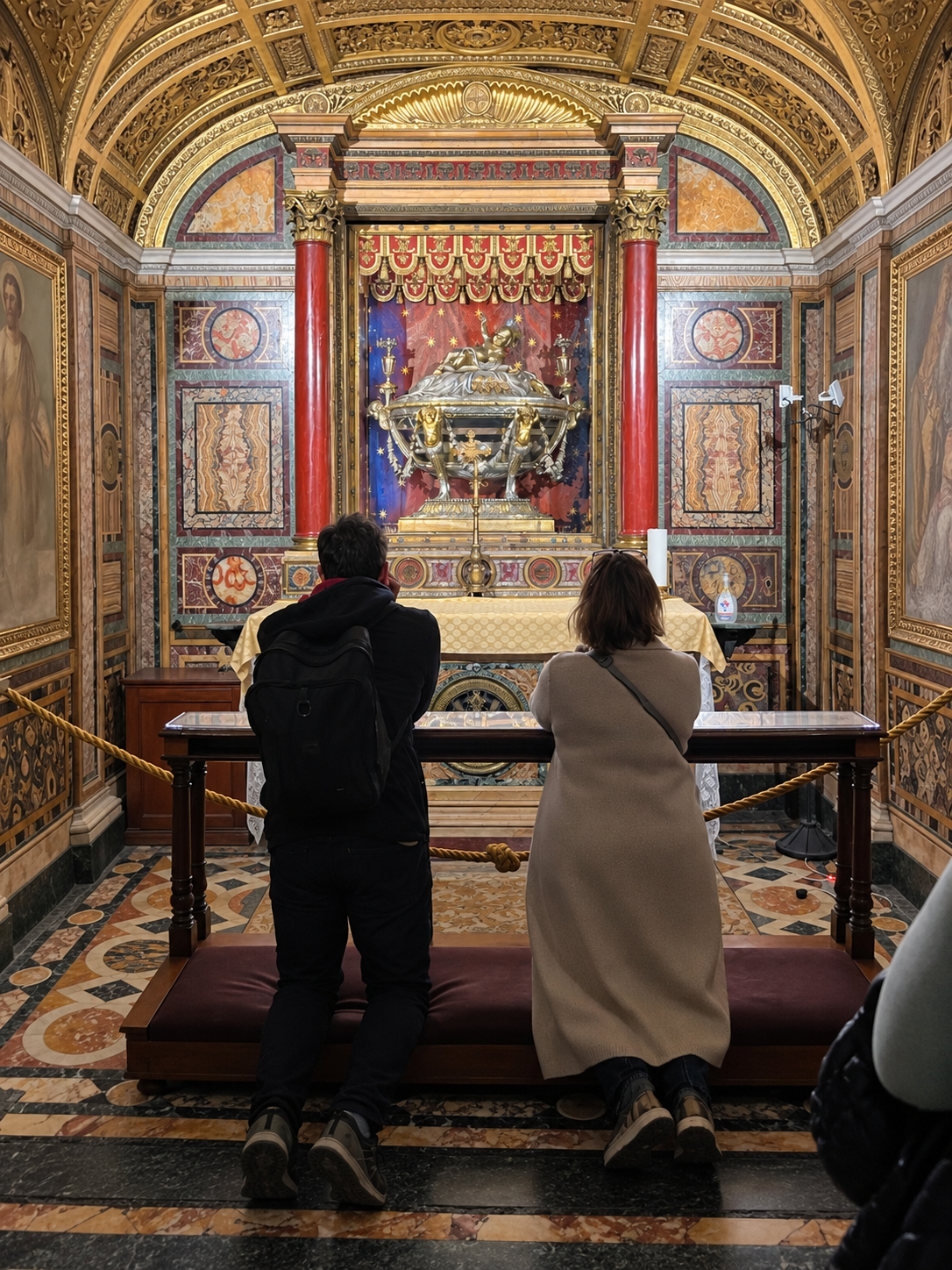
Tradition holds that the relics reached Rome during the seventh century, when the Holy Land faced invasion and its Christian shrines were endangered. They were entrusted to Santa Maria Maggiore, where devotion to Christ’s Nativity had already flourished for generations. Five surviving pieces of ancient wood are now preserved within an elegant crystal and silver-gilt reliquary designed by the Roman architect and goldsmith Giuseppe Valadier in 1802. Its transparent, cradle-like form allows the faithful to contemplate the humble wooden remains while recalling the mystery of the Incarnation.
The reliquary is housed in the Confessio beneath the papal high altar. This richly decorated subterranean chapel was created in the nineteenth century by Virginio Vespignani at the request of Pope Pius IX, whose kneeling statue faces the Holy Crib in perpetual veneration. The relics are exposed with particular solemnity during the Christmas season, drawing pilgrims from throughout the world. In 2019, Pope Francis presented a small fragment of the Holy Crib to the Franciscan Custody of the Holy Land; it was returned to Bethlehem and placed in the Church of Saint Catherine beside the Basilica of the Nativity.
For Christian pilgrims, the Holy Crib is more than a historical memorial. Its rough wooden pieces direct the imagination toward the poverty and humility of Christ’s birth: the eternal Word entered human history not in a royal palace, but in the simplicity of a stable. Venerated beside the basilica’s celebrated icon of the Virgin, Salus Populi Romani, the relics unite devotion to the Christ Child with love for His Mother. Santa Maria Maggiore thus remains a Roman sanctuary of the Incarnation—a place where sacred art, ancient tradition, and living prayer lead the faithful spiritually back to Bethlehem.