



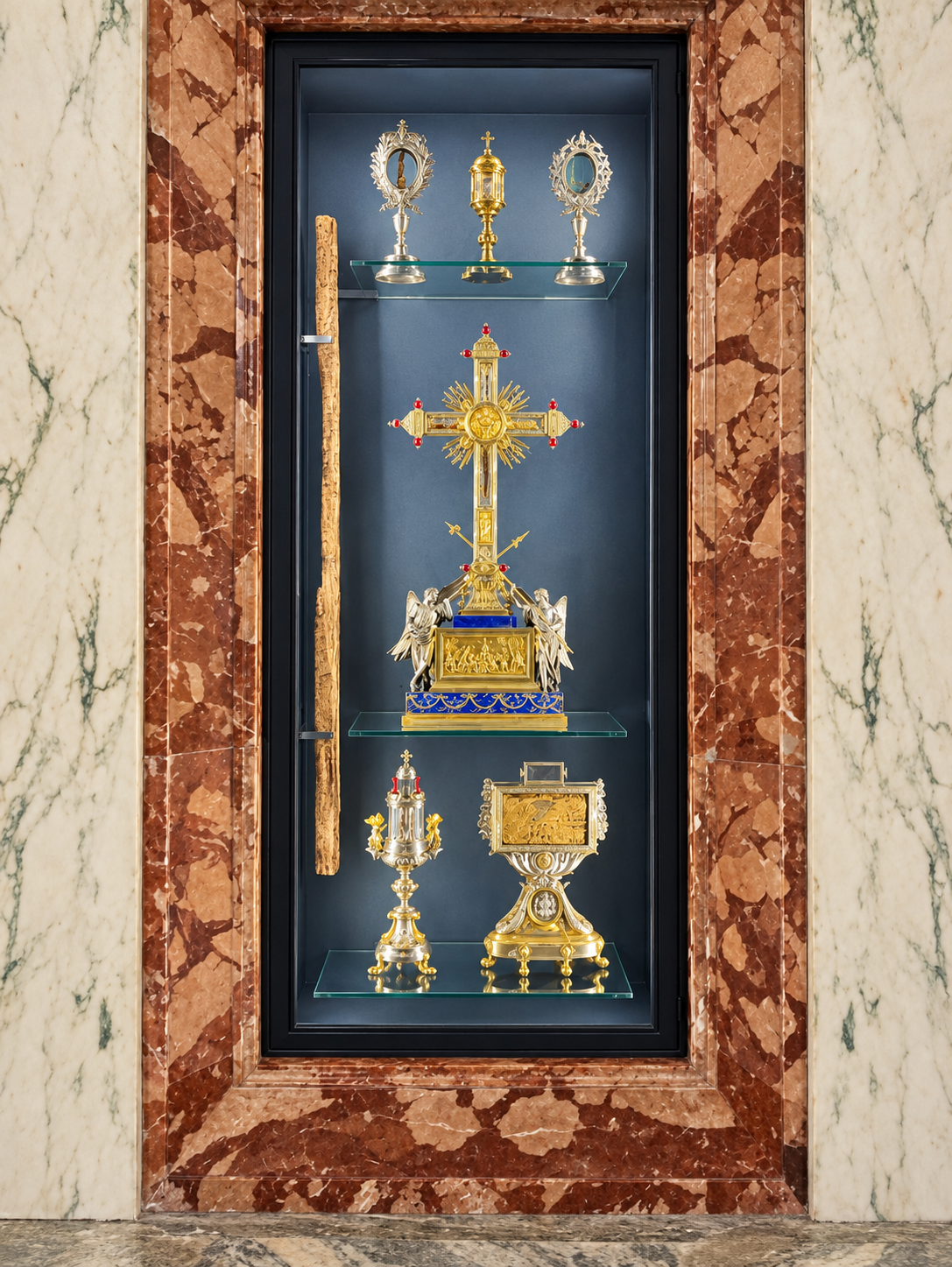
 The Basilica of the Holy Cross in Jerusalem—Santa Croce in Gerusalemme—occupies a unique place among the ancient churches of Rome. Rather than merely commemorating Jerusalem, it was conceived as a spiritual extension of the Holy City: a Roman sanctuary in which the material memories of Christ’s Passion could be preserved and venerated.
The basilica stands on the remains of the Sessorium, an imperial residential complex developed by the Severan emperors during the third century. In the early fourth century it became the residence of Saint Helena, mother of Emperor Constantine. According to Christian tradition, Helena made a pilgrimage to Jerusalem around 325 and discovered the True Cross on Calvary. She brought portions of the Cross and other Passion relics to Rome, together with earth from the holy places. Part of the Sessorian palace was transformed into a chapel to house these sacred objects, forming the nucleus of the future basilica, initially known as the Basilica Heleniana or Sessoriana. The presence of soil believed to have come from Calvary explains the designation “in Jerusalem”: pilgrims entering the sanctuary symbolically entered the sacred ground of the Holy City.
The church was restored by Popes Gregory II and Hadrian I during the eighth century. In the twelfth century, Pope Lucius II reconstructed it as a Romanesque basilica with three naves, a portico, and a brick bell tower. During renovations commissioned by Cardinal Pedro González de Mendoza in the late fifteenth century, a wooden tablet identified as the Titulus Crucis was discovered concealed within the triumphal arch. The basilica received its present late-Baroque appearance under Pope Benedict XIV, who engaged Pietro Passalacqua and Domenico Gregorini to redesign the façade, atrium, and interior during the eighteenth century.
The Passion relics were originally preserved in Saint Helena’s chapel. They were transferred to a more secure location during the sixteenth century and, in 1931, installed in the present Chapel of the Relics. The chapel is approached through a gently rising corridor intended to evoke the ascent to Calvary. Within its glass-fronted shrine are three fragments traditionally identified as portions of the True Cross, a Holy Nail, two thorns from Christ’s Crown of Thorns, part of the cross of the Good Thief, and the Titulus Crucis. The latter bears portions of the inscription “Jesus of Nazareth, King of the Jews” in Hebrew, Greek, and Latin, written from right to left. Other sacred memorials include fragments associated with the Holy Sepulchre and the Grotto of the Nativity, as well as a finger bone attributed to Saint Thomas the Apostle.
Together, the Cross, Nail, Thorns, title, and patibulum belong to the devotional tradition of the Arma Christi—the Instruments of Christ’s Passion. Their purpose is not simply historical display. Presented in precious reliquaries, they form a visual catechesis on the Incarnation, Crucifixion, and Resurrection. For centuries, pilgrims have prayed before them as tangible witnesses to Christ’s redemptive suffering. As one of Rome’s traditional Seven Pilgrim Churches, Santa Croce allows the faithful to make a spiritual pilgrimage to Calvary without leaving Rome, transforming remembrance of the Passion into an intimate act of prayer, gratitude, and veneration.